Champagne Market is projected to reach USD 27.85 billion by 2035, driven by premiumization, evolving consumption occasions, rosé demand, & APAC expansion.
NEW YORK, NY, UNITED STATES, August 28, 2026 /EINPresswire.com/ —
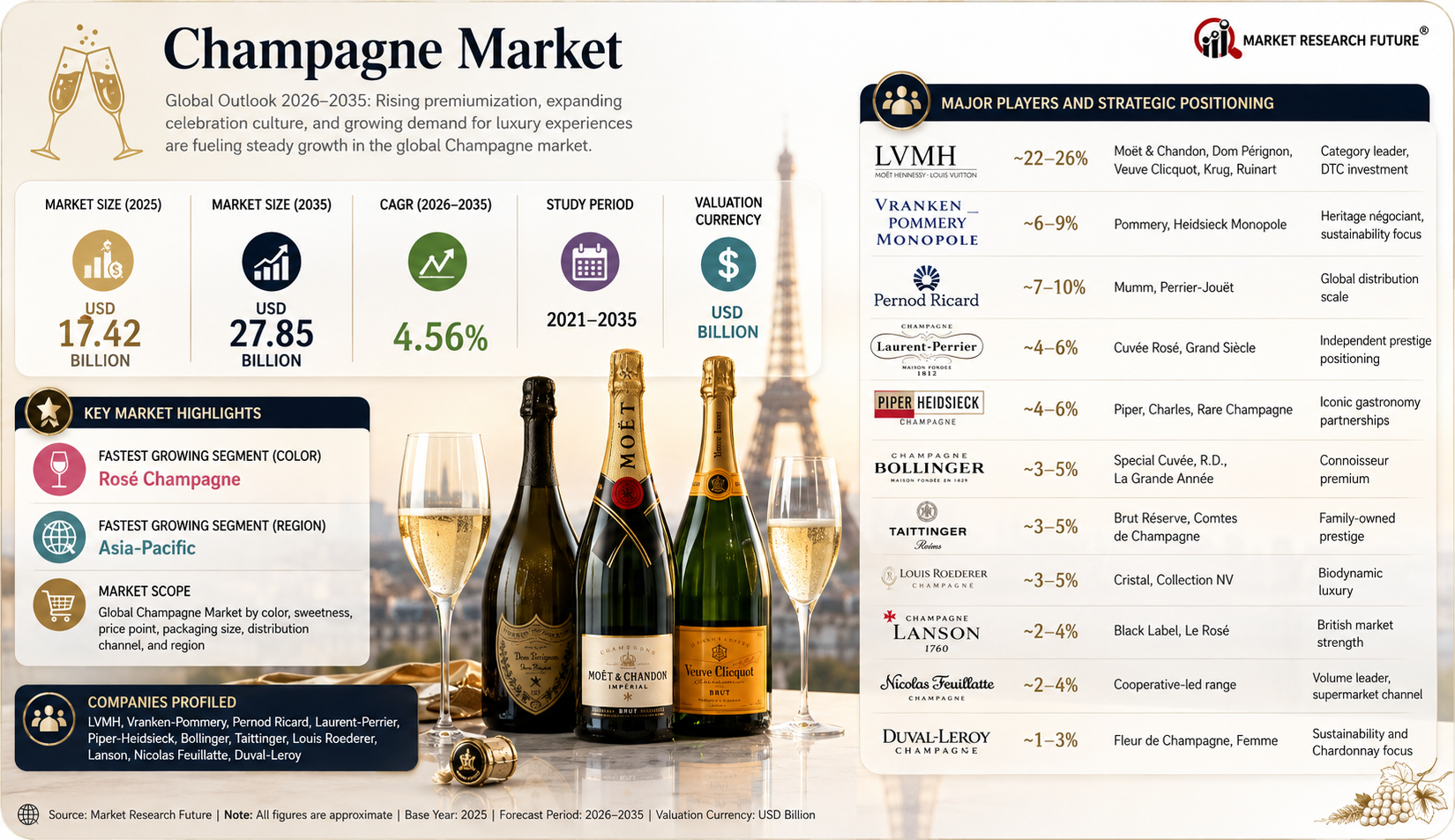
The global Champagne Market is entering a sustained growth phase as premium alcoholic beverages increasingly become associated with celebration, luxury, gastronomy, gifting, and experiential consumption. Based on the provided market assessment, the market is valued at USD 17.42 billion in 2025 and is projected to reach USD 27.85 billion by 2035, expanding at a 4.56% CAGR from 2026 to 2035. Growth is being shaped by premiumization, the expansion of luxury beverage consumption, changing preferences toward rosé Champagne, stronger e-commerce and direct-to-consumer engagement, and increasing demand from emerging markets.
The competitive landscape remains concentrated around established Champagne houses and diversified beverage groups. LVMH holds an estimated 22–26% revenue share, supported by Moët & Chandon, Dom Pérignon, Veuve Clicquot, Krug, and Ruinart. Pernod Ricard follows with approximately 7–10%, while Vranken-Pommery Monopole represents around 6–9%. Other important participants include Laurent-Perrier, Piper-Heidsieck/Charles Heidsieck, Bollinger, Taittinger, Louis Roederer, Lanson, Nicolas Feuillatte, and Duval-Leroy. LVMH has also reported that its Champagne houses maintained approximately 22% of Champagne-appellation shipments in 2025, reinforcing its strong competitive position.
“Free Sample Copy” – Access A Complimentary Copy of Our Report to Explore Its Content and Insights
https://www.marketresearchfuture.com/sample_request/11609
Champagne Market Growth Drivers
One of the principal drivers is premiumization. Consumers are increasingly willing to pay for provenance, craftsmanship, limited releases, vintage expressions, prestigious cuvées, and recognizable maisons. Champagne benefits from a powerful luxury positioning that differentiates it from conventional sparkling wine. Prestige labels are expanding their role beyond traditional celebrations into fine dining, luxury hospitality, fashion, entertainment, and experiential events. LVMH’s Champagne portfolio illustrates this strategy, with brands spanning accessible prestige through highly collectible offerings. The group’s Champagne activities showed encouraging signs of recovery in 2026, particularly in prestige cuvées.
A second driver is the expansion of consumption occasions. Champagne is increasingly marketed and consumed not only during weddings, anniversaries, and holidays but also at brunches, restaurants, social gatherings, corporate events, sporting occasions, and premium nightlife venues. Innovative formats and serving styles are helping brands attract younger legal-drinking-age consumers while maintaining luxury credentials. For example, Moët & Chandon’s Ice Impérial was developed specifically for consumption over ice, demonstrating how product innovation can challenge traditional serving conventions while preserving the category’s premium identity.
Market Segmentation Analysis
By Color
The market can be segmented into white Champagne and rosé Champagne, with rosé Champagne identified as the fastest-growing color segment. White Champagne remains the dominant category because of its established consumer base, broad availability, and suitability across dining and celebration occasions. Brut styles remain particularly important because their balanced sweetness profile supports pairing with a wide variety of foods.
Rosé Champagne, however, is gaining momentum through its visual appeal, premium positioning, and association with lifestyle-oriented consumption. Producers use different techniques, including assemblage and maceration, to create distinctive color, aroma, structure, and fruit intensity. Its suitability for restaurants, gifting, summer occasions, and premium social events provides additional growth opportunities.
By Sweetness
Brut, Extra Brut, Brut Nature, and sweeter Champagne styles represent important sweetness categories. Brut continues to command broad demand because it offers a versatile balance between acidity, fruit character, and residual sugar. Extra Brut and Brut Nature are attracting consumers who prefer drier profiles and greater emphasis on terroir and winemaking precision.
Sweetness segmentation also allows Champagne houses to target different consumer preferences without abandoning the core appellation identity. As wine knowledge expands, consumers increasingly explore dosage levels and flavor profiles, creating opportunities for producers to educate customers through tasting experiences and digital content.
By Price Point
The price-point segment ranges from standard premium offerings to super-premium and prestige Champagne. Standard premium products benefit from wider retail distribution and are commonly purchased for celebrations and gifting. Premium and luxury tiers, meanwhile, generate significant value through limited production, extended aging, vintage designation, exceptional vineyard sourcing, and brand heritage.
Prestige Champagne is particularly important to the industry’s value proposition because scarcity and craftsmanship can support significantly higher price realization. Dom Pérignon, Cristal, Krug, Comtes de Champagne, and other high-end cuvées exemplify the strategy of building long-term desirability rather than competing primarily on volume. LVMH reported that prestige cuvées were among the areas showing encouraging momentum in 2026.
By Packaging Size
Packaging size includes standard bottles, half bottles, magnums, and larger formats. Standard bottles remain the primary commercial format because of their convenience and established consumer familiarity. Half bottles are relevant to restaurants, hotels, and controlled-consumption occasions, while magnums and larger formats are increasingly associated with celebrations, hospitality, premium gifting, and collectors.
Packaging is also becoming a sustainability consideration. The Champagne industry has been developing a dedicated glass strategy focused on performance, innovation, and environmental responsibility, recognizing that bottles are integral to the wine’s production, aging, and preservation rather than merely being containers.
By Distribution Channel
The distribution channel comprises supermarkets and hypermarkets, specialty stores, restaurants and hospitality, e-commerce, and other channels. Supermarkets remain important for volume-driven Champagne sales, particularly for established non-vintage labels. Specialty wine retailers provide greater opportunities for premium and vintage products because consumers can receive expert guidance.
Restaurants, hotels, and luxury hospitality establishments remain strategically important because Champagne is strongly connected with gastronomy and experiential consumption. Meanwhile, e-commerce and direct-to-consumer channels are expanding opportunities for brand storytelling, personalized recommendations, limited releases, and direct engagement. Leading luxury houses are investing in digital brand experiences while maintaining selective distribution to protect exclusivity.
By Region
Geographically, Europe remains the industry’s core market, supported by Champagne’s French heritage, established consumption culture, tourism, gastronomy, and mature distribution infrastructure. North America represents another important premium market, supported by luxury consumption and strong restaurant and hospitality demand.
Asia-Pacific is projected to be the fastest-growing regional market. Rising disposable incomes, urbanization, premium lifestyle consumption, luxury retail expansion, and growing interest in wine culture are supporting demand. China, Japan, India, Singapore, South Korea, and Australia offer different but complementary opportunities. The region’s growth is particularly relevant to premium and prestige Champagne, where brand heritage and exclusivity can appeal to affluent consumers.
Competitive Landscape and Key Players
Competition is based on brand equity, vineyard access, blending expertise, distribution reach, product innovation, sustainability, pricing strategy, and luxury positioning. LVMH maintains a particularly diversified Champagne portfolio and has invested in both brand desirability and direct consumer engagement.
Vranken-Pommery Monopole leverages heritage and sustainability, while Pernod Ricard benefits from the international distribution capabilities of Mumm and Perrier-Jouët. Pernod Ricard reported double-digit growth for Perrier-Jouët across all regions in the first half of FY26, demonstrating the potential of premium Champagne brands with global reach.
Laurent-Perrier emphasizes independent prestige positioning, while Piper-Heidsieck and Charles Heidsieck focus on iconic brand identity and gastronomy. Bollinger appeals strongly to connoisseurs through premium cuvées, whereas Taittinger combines family ownership with prestige positioning. Louis Roederer differentiates through luxury and biodynamic-oriented practices. Lanson has established strength in the British market, while Nicolas Feuillatte benefits from its cooperative structure and broader-volume orientation. Duval-Leroy emphasizes Chardonnay and sustainability.
Industry Developments
1. Champagne industry strengthens its sustainability framework. In 2025, the Comité Champagne launched a comprehensive Corporate Social Responsibility strategy covering economic, environmental, and societal priorities. The industry has also reported progress in reducing its carbon footprint, pesticide and nitrogen fertilizer use, and waste, while increasing environmental certification across vineyard areas.
2. Packaging innovation becomes a strategic sustainability priority. In November 2025, the Comité Champagne introduced a dedicated glass strategy focused on bottle performance, innovation, and environmental responsibility. This development highlights how packaging optimization is becoming part of Champagne’s broader sustainability and competitiveness agenda.
Future Outlook
The Champagne Market is expected to benefit from the intersection of luxury consumption, premiumization, experiential drinking, product innovation, and geographic diversification. The projected increase from USD 17.42 billion in 2025 to USD 27.85 billion by 2035, representing a 4.56% CAGR during 2026–2035, indicates a market increasingly focused on value creation rather than volume alone.
Future competition will likely center on premium brand storytelling, sustainable viticulture, packaging efficiency, selective distribution, digital engagement, and deeper penetration into Asia-Pacific. Rosé Champagne is positioned for particularly strong growth, while prestige and premium price tiers are expected to remain important contributors to market value.
FAQs
1. What is driving the Champagne Market growth?
Premiumization, luxury consumption, expanding celebration occasions, rosé Champagne demand, product innovation, e-commerce, and growing consumption in Asia-Pacific are key growth drivers.
2. Which region is expected to grow fastest in the Champagne Market?
Asia-Pacific is projected to be the fastest-growing regional segment, supported by rising disposable incomes, urbanization, luxury consumption, and expanding wine culture.
Read Our Related Research Report
Premium Wine Market –
https://www.marketresearchfuture.com/reports/premium-wine-market-35495
Luxury Wines and Spirits Market –
https://www.marketresearchfuture.com/reports/luxury-wines-spirits-market-7236
Non-alcoholic Champagnes Market –
https://www.marketresearchfuture.com/reports/non-alcoholic-champagnes-market-22620
Sagar Kadam
Market Research Future
+1 628-258-0071
email us here
Legal Disclaimer:
EIN Presswire provides this news content “as is” without warranty of any kind. We do not accept any responsibility or liability
for the accuracy, content, images, videos, licenses, completeness, legality, or reliability of the information contained in this
article. If you have any complaints or copyright issues related to this article, kindly contact the author above.

Media gallery