
Key Takeaways
- Every step generates a downward “heel lift force” that actively pulls low-cut socks toward the toe box – no-show socks are the most vulnerable sock style to this force.
- Most no-show socks fail because of a narrow silicone strip and a shallow heel pocket – two design flaws that make slippage nearly inevitable under real work conditions.
- Sweat is a force multiplier: moisture significantly reduces a borderline grip’s effectiveness, potentially leading to complete failure, especially within the first hour of a shift.
- The fix is specific – wide-coverage silicone grip, a deep heel pocket, and moisture-wicking fabric; Mason Workwear’s Tradesman No-Show Socks are built around exactly these principles.
- Sizing errors compound every other failure – even a well-built sock will slide if it’s the wrong size.
No-show socks slip. Every tradesman who has tried them knows the routine: five minutes into the job, one heel is already crawling toward the arch, and by lunch the sock is bunched under the ball of the foot like a wadded receipt. The frustrating part is that the problem has nothing to do with the style – the physics are the real culprit. Understanding what’s actually happening underfoot explains why cheap no-shows fail, and what separates a sock that stays put from one that doesn’t.
Your Heel Is Pulling Your Sock Down With Every Step
The heel is not a passive structure during walking. With each stride, it lifts off the insole, travels upward, and drives back down – a repetitive cycle that generates a consistent downward drag on any fabric sitting below the ankle bone. This is heel lift force, and it is the primary mechanical reason no-show socks slip.
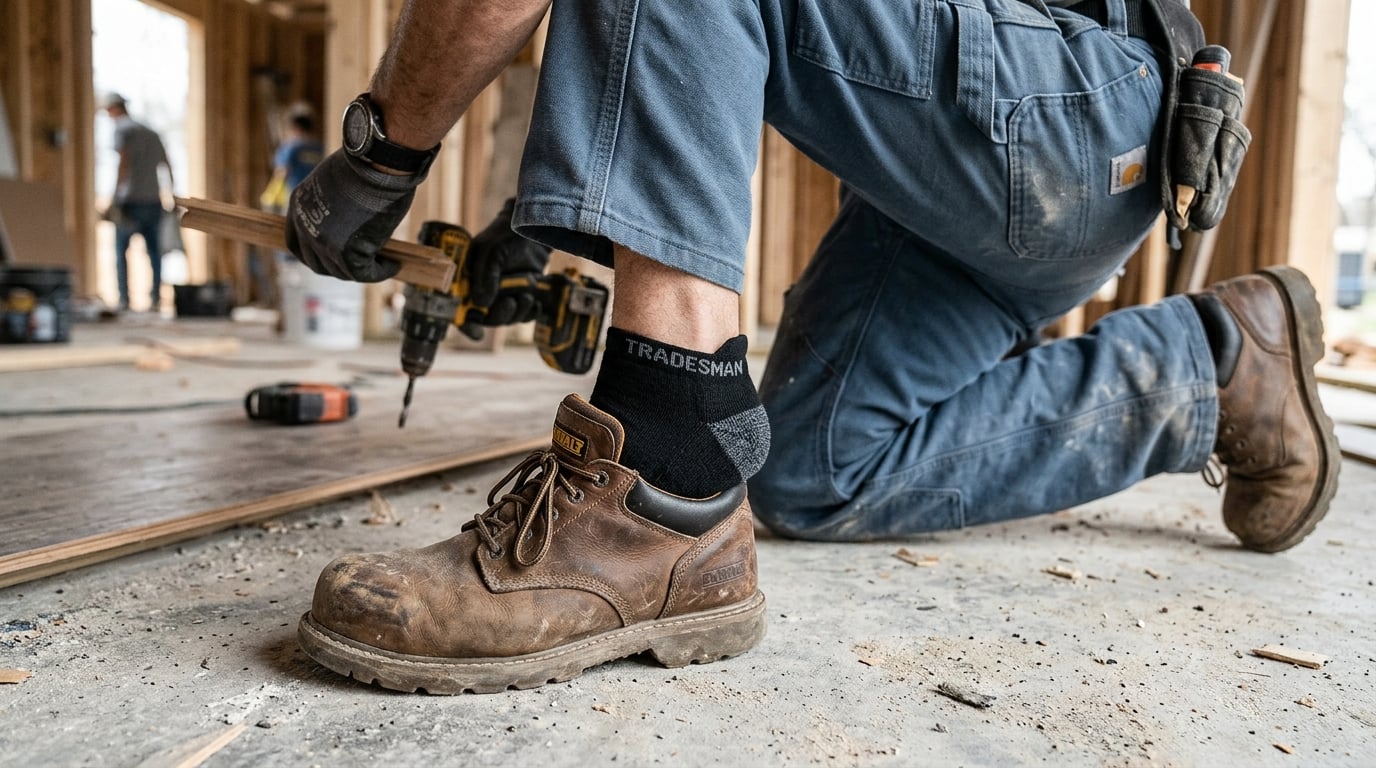
For tradesmen covering concrete floors, climbing ladders, or moving across job sites for eight-plus hours, that cycle repeats thousands of times per shift. Each repetition tugs the sock heel slightly downward. A sock without the grip and structure to resist that pull loses ground incrementally – millimeter by millimeter – until it has completely detached from the heel and collapsed under the foot. This force is the starting point for understanding why most no-show socks are poorly suited to the demands of physical work. Mason Workwear’s Tradesman No-Show Socks were engineered specifically around this problem, which is worth keeping in mind as the physics unfolds.
What Heel Lift Force Actually Does
The Downward Pull Generated During Walking
When the heel rises, the sock fabric is momentarily anchored by the shoe interior at the toe and midfoot. The heel of the sock, no longer pinched between skin and insole, is free to migrate. Biomechanical research confirms that in-shoe foot displacement – the movement of the foot relative to the shoe interior – is directly influenced by friction at the foot-sock-footwear interface. High-friction socks measurably reduce this displacement. Low-friction socks allow the foot to shift freely, and the heel of the sock follows that shift downward.
The force is not large in isolation. Across a full shift, however, it accumulates into a total displacement that no thin strip of silicone can absorb.
Why Low-Cut Socks Are Most Vulnerable
A crew sock or quarter-length sock has fabric extending above the ankle, which distributes the heel lift force across a wider surface and provides additional anchoring points against the shoe collar. A no-show sock has none of that. Its entire grip on the foot is concentrated at the heel – a zone that is simultaneously the point of maximum force and the point of minimum fabric coverage. That geometry is unforgiving. A design flaw that would be minor in a crew sock becomes a guaranteed failure point in a no-show.
Narrow Grip Physics: Why Most No-Shows Fail
The Surface Area Problem With Thin Silicone Strips
Most budget no-show socks include a single thin strip of silicone rubber along the inner heel seam. The logic is sound – silicone creates friction – but the execution ignores basic surface area physics. Friction resistance is proportional to contact area. A grip strip covering 10-15% of the heel contact zone generates a fraction of the holding force of a grip system covering 40% or more of that same zone.
During heel lift, that narrow strip peels away from the skin the moment the sock fabric flexes. The silicone is pressed against the skin, not bonded to it. With minimal contact area, the slightest reduction in perpendicular force – which happens every time the heel rises – breaks that contact entirely. The sock then gets pulled downward by the weight of the fabric and the friction of the insole against the sock’s exterior.
Shallow Heel Pockets Make It Worse
A shallow heel pocket compounds the surface area problem. The heel pocket is the three-dimensional cup of fabric shaped to wrap around the back and bottom of the heel bone. When it’s too shallow, the sock sits on the curve of the heel rather than wrapping beneath it. This position is structurally the worst location to resist downward force – the sock is balanced on the widest point of the heel, with nothing below the bone to anchor it.
A deep heel pocket wraps below the heel bone and uses the geometry of the heel itself as a ledge. Gravity and downward force then work against displacement rather than with it. Poor anatomical design – specifically the absence of a defined heel cup that closely follows the heel’s contour – is consistently identified as a root cause of no-show slippage. That’s a design choice, not an inevitable limitation of the sock style.
Sweat Turns a Grip Problem Into a Slip Guarantee
Tradesmen sweat. That’s a working condition, not a complaint. Sweat is also chemically hostile to silicone grip performance. Moisture acts as a lubricant at the silicone-skin interface, reducing the coefficient of friction between the grip surface and the heel. A grip system that holds adequately in dry conditions can fail significantly once a light film of sweat develops – and for tradesmen on long shifts, that film arrives quickly.
This effect compounds further on most job sites. Dust and fine particulate mix with sweat to create a slurry between the grip surface and the skin, producing conditions close to a greased heel. A sock with marginal grip under dry conditions has no realistic chance of holding through a sweaty summer shift. Moisture-wicking fabric addresses part of this by pulling sweat away from the skin surface before it saturates the sock, but the grip system itself also needs to be robust enough to maintain contact under damp conditions.
Sizing Errors Compound Every Other Failure
A sock that is too large has excess fabric in the heel pocket. That slack means the sock is never under proper tension against the heel – the silicone grip sits loosely draped over skin rather than pressed firmly against it. Any heel lift force immediately finds that slack and exploits it.
A sock that is too small stretches the heel pocket upward, pulling it above the shoe collar and defeating the entire purpose of a no-show design. Either sizing error eliminates the structural advantages of even a well-built grip system. No-show socks have essentially zero sizing tolerance compared to crew socks, because there is no ankle fabric to absorb slack or compression. Getting the size right is a prerequisite for everything else to work.
What Actually Keeps a No-Show Sock on a Tradesman’s Foot
The solution to heel lift force and narrow grip physics requires manufacturers to actually engineer for it rather than scaling down a crew sock pattern.
Wide-Coverage Silicone Grip
Grip patterning needs to cover the full inner heel zone, not a single strip at the seam. A wide-coverage silicone system maintains contact with skin through the full range of heel motion – including the lift phase where narrow strips lose contact entirely. More surface area means more friction, and more friction means the sock stays anchored even as force repeatedly tries to pull it down.
Deep Heel Pocket Depth
The heel pocket needs to wrap below the heel bone, using the heel’s own geometry as a structural anchor. This design positions the sock so that downward force drives the heel further into the pocket rather than pushing the sock out of it. The difference between a shallow cut and a true deep pocket is the difference between a sock balanced on a ledge and one locked around it.
Moisture-Wicking Materials
Moisture-wicking fibers pull sweat away from the skin surface before it accumulates at the grip interface. This keeps the silicone-to-skin contact zone drier for longer, preserving friction performance through extended wear. For tradesmen working long shifts in boots with limited ventilation, moisture management is a grip preservation strategy, not a comfort bonus.
Cheap Construction Is the Real Culprit – Not the Sock Style
No-show socks get a bad reputation that belongs to bad no-show socks. The slipping, the bunching, the sock ending up under the ball of the foot by mid-morning – none of that is an inherent property of the low-cut style. These are the predictable outcomes of manufacturing choices that prioritize cost over function: narrow grip strips, shallow heel pockets, cotton-heavy blends that hold moisture, and sizing tolerances too loose for a sock with no margin for error.
For tradesmen, the calculus is straightforward. A no-show sock that slips creates a friction point that causes blisters, and blisters on a job site are a real productivity problem. Research in sports science links internal foot movement inside footwear directly to blister formation – the same mechanism at work in a work boot when a sock fails to hold position. The sock style is not the enemy. The engineering is.
For tradesmen who want no-show options built around these principles, Mason Workwear specializes in workwear-grade socks designed for the specific demands of physical trades.
Mason Workwear
support@masonclothing.com
+1 (760) 286-4266
5830 E 2nd St Casper WY 82609
United States
Wyoming (WY)
82609
United States


