AndaSeat Connects Phantom 4, Phantom 4 Pro, Kaiser 3E, and Kaiser 3 to a Growing Consumer Need: Chair Comparison
SPOKANE, WA, UNITED STATES, June 22, 2026 /EINPresswire.com/ — AndaSeat is highlighting four core ergonomic chair models — Phantom 4, Phantom 4 Pro, Kaiser 3E, and Kaiser 3 — as part of a broader response to a consumer issue that has become more visible in the current market: as buyers grow more price-conscious, they increasingly want clearer differences between product tiers before making a higher-consideration purchase.
In many categories, consumers are no longer satisfied with broad “premium” or “entry-level” labels alone. They want to understand what changes meaningfully from one model to another, how those differences affect fit and everyday use, and whether a higher price actually corresponds to a different ergonomic experience rather than only to styling or branding. In ergonomic seating, this creates a more specific expectation: buyers want a lineup that feels easier to compare across body fit, armrest type, lumbar logic, included accessories, and price level.
AndaSeat said its current four-model lineup is being positioned with that kind of comparison in mind. Rather than presenting one chair as universally best for all buyers, the company is framing the range as a set of distinct ergonomic pathways designed for different support preferences, adjustment priorities, and budgets.
Why Comparison Clarity Has Become More Important
Buying behavior has become more deliberate in categories tied to home setup and daily-use furniture. When shoppers feel more selective, they often compare features more closely and spend more time trying to understand what actually changes between adjacent models. For ergonomic chairs, that often means looking beyond broad comfort language and focusing on more concrete questions: Does the chair use fixed support or motion-responsive support? Is the armrest system basic or highly adjustable? Does the chair fit a narrower body range or a wider one? Is the included head support standard or more advanced?
This creates a challenge for brands as well as consumers. If the lineup is too vague, buyers may struggle to understand why one chair sits at one price point and another higher up. But if the lineup is structured clearly, the product comparison itself becomes part of the value proposition.
AndaSeat said this was part of the rationale for how Phantom 4, Phantom 4 Pro, Kaiser 3E, and Kaiser 3 are currently being presented together.
The Consumer Pain Point Behind the Lineup
One of the more familiar frustrations in furniture buying is that shoppers often do not regret choosing a lower-priced product because it costs less. They regret choosing a product whose real differences were unclear until after purchase. In ergonomic chairs, that can happen when a buyer expects one kind of support feel but receives another, or when body fit, armrest movement, or lumbar behavior turn out to matter more than expected in daily use.
For many consumers, the issue is not simply affordability. It is confidence in making the right tradeoff. In practical terms, buyers want to know whether they are paying for more movement-led support, more dimensional fit, more traditional premium construction, or simply a different version of the same experience.
AndaSeat said its four-model lineup is being framed to address that problem more directly. The company is effectively treating comparison clarity as part of the product story rather than leaving buyers to infer all meaningful differences on their own.
How AndaSeat Frames Phantom 4
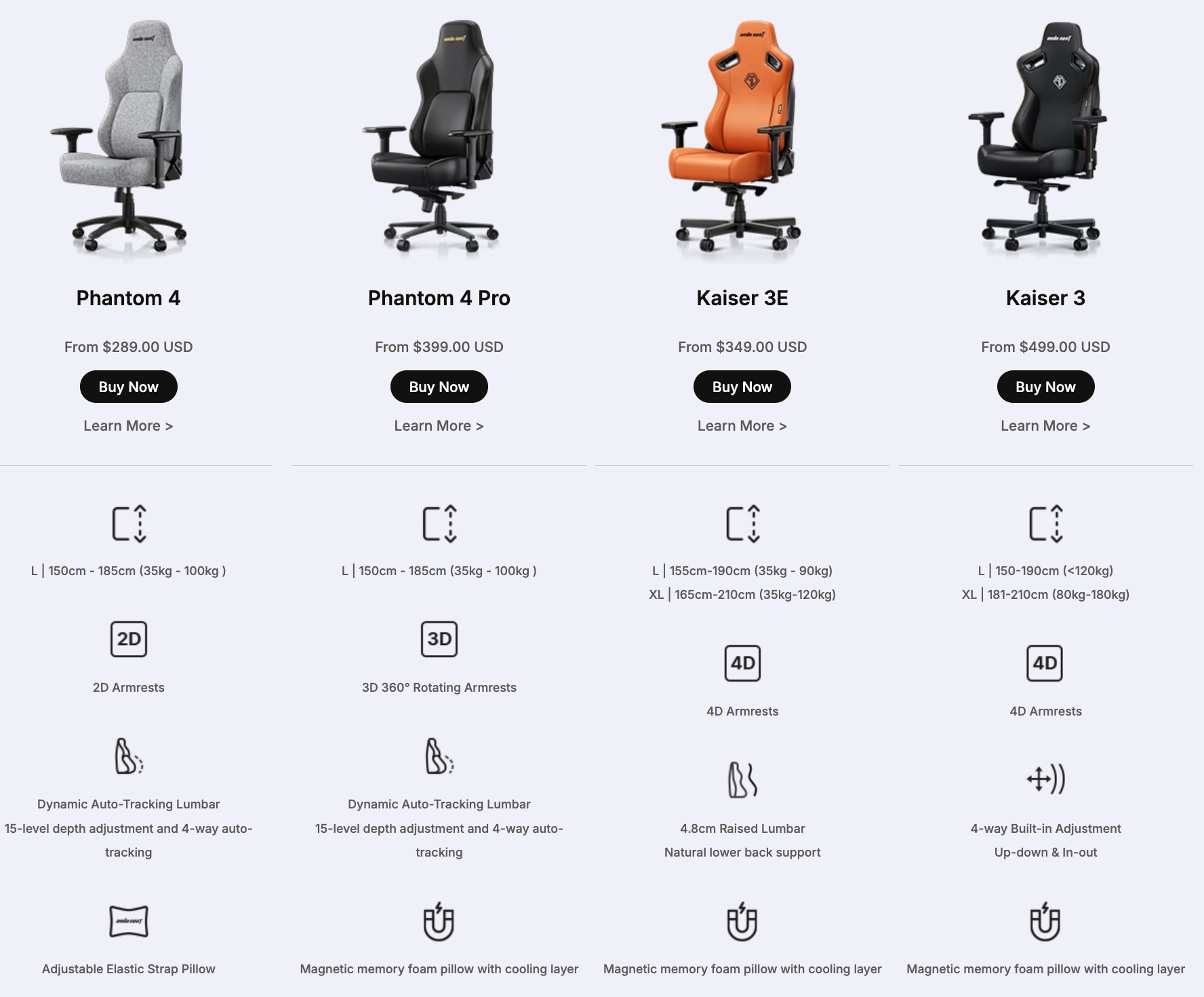
According to AndaSeat, Phantom 4 is the motion-oriented entry point in the lineup. The chair is positioned around dynamic auto-tracking lumbar support, 15-level depth adjustment, 4-way auto-tracking support, 55 kg/m³ cold-cure foam, 2D armrests, and an adjustable elastic strap pillow.
In practical terms, Phantom 4 is being presented as a chair for users who want a more movement-responsive support system without moving immediately into the upper tier of the lineup. Its defining ergonomic logic is not simply that it includes support, but that the support responds to posture shifts more actively than traditional fixed systems.
This gives Phantom 4 a clear place in the comparison structure: it is the accessible motion-led option.
How AndaSeat Frames Phantom 4 Pro
AndaSeat positions Phantom 4 Pro as the more fully featured extension of that same movement-oriented concept. The company states that the chair builds on Phantom 4’s core dynamic lumbar system while adding 3D 360-degree rotating armrests, a magnetic memory foam pillow with cooling layer, and a different support-accessory profile.
Within the lineup, Phantom 4 Pro is therefore framed not as a different ergonomic philosophy, but as the more advanced version of the same philosophy. It is designed for buyers who are already interested in motion-responsive seating and want broader arm adjustment and upgraded neck support without leaving the Phantom family.
That gives the model a specific role in the comparison set: it is the feature-expanded motion-led chair.
How AndaSeat Frames Kaiser 3E
According to AndaSeat, Kaiser 3E offers a different support pathway. Instead of dynamic auto-tracking lumbar, the chair is centered on a 4.8 cm raised lumbar form designed to provide a more natural lower-back support profile, together with 4D armrests and a magnetic memory foam pillow with cooling layer.
This matters in the lineup because Kaiser 3E is not being positioned as simply “more” or “less” than Phantom 4. It reflects a different ergonomic assumption. Where Phantom 4 emphasizes support that follows movement, Kaiser 3E emphasizes a more stable built-in lumbar feel paired with broader armrest adjustability.
That makes Kaiser 3E the more structure-led mid-tier choice for buyers who want a more anchored support profile rather than a motion-responsive one.
How AndaSeat Frames Kaiser 3
AndaSeat positions Kaiser 3 as the more established premium chair platform within this comparison group. The company identifies it with 4-way built-in lumbar adjustment, 4D armrests, magnetic memory foam pillow with cooling layer, broader size coverage, and a more traditional premium flagship profile.
Within the lineup, Kaiser 3 is being framed as the chair for users who prioritize dimensional fit, mature adjustability, and a more traditional high-end ergonomic architecture rather than the newer movement-led support logic of Phantom 4. Its role in the comparison is therefore not to duplicate the other models, but to give buyers a more conventional premium route into the lineup.
This gives the chair a distinct purpose: it is the established premium structure-led option.
Why the Four-Chair Comparison Matters
What makes this four-model story notable is that it gives consumers a more usable way to think about ergonomic buying. Instead of a lineup built around vague hierarchy, AndaSeat is effectively organizing the chairs around two comparison axes: movement-led versus structure-led support, and entry-to-mid versus more premium feature depth.
That helps answer a current buyer concern. In a more price-sensitive environment, consumers often do not want to pay more only because a chair sits higher in the lineup. They want to understand which specific ergonomic logic they are paying for. A chair that follows movement, a chair with broader armrest control, a chair with more size-conscious premium fit, and a chair with more anchored built-in lumbar all reflect different purchase priorities.
By structuring Phantom 4, Phantom 4 Pro, Kaiser 3E, and Kaiser 3 in this way, AndaSeat is positioning the lineup not only as a group of products, but as a clearer comparison framework.
Why This Product Story Matters Now
What distinguishes this product story from a conventional launch message is the issue it addresses. This is not mainly a story about one new chair or one sale event. It is a story about a market condition in which consumers are increasingly selective, more comparison-driven, and more likely to scrutinize feature differences before choosing a large daily-use item.
In that environment, clarity itself becomes a product advantage. AndaSeat said its current chair lineup is being presented with that principle in mind: not every buyer needs the same seat, but more buyers now expect a clearer explanation of what each seat is actually designed to do.
About the Lineup
The featured AndaSeat lineup includes Phantom 4, Phantom 4 Pro, Kaiser 3E, and Kaiser 3. According to the company, the models represent different ergonomic pathways across motion-responsive lumbar support, built-in lumbar structure, armrest systems, support accessories, and fit profiles.
About AndaSeat
Founded in 2007, AndaSeat develops ergonomic furniture products for gaming, work, and home environments. Its product portfolio includes ergonomic chairs, desks, and related workspace products designed for hybrid users, home setups, and gaming spaces.
Caroline Chen
AndaSeat
+ + 86 139 2232 2347
email us here
Visit us on social media:
LinkedIn
Instagram
Facebook
YouTube
TikTok
X
Legal Disclaimer:
EIN Presswire provides this news content “as is” without warranty of any kind. We do not accept any responsibility or liability
for the accuracy, content, images, videos, licenses, completeness, legality, or reliability of the information contained in this
article. If you have any complaints or copyright issues related to this article, kindly contact the author above.

Media gallery