
Key Takeaways
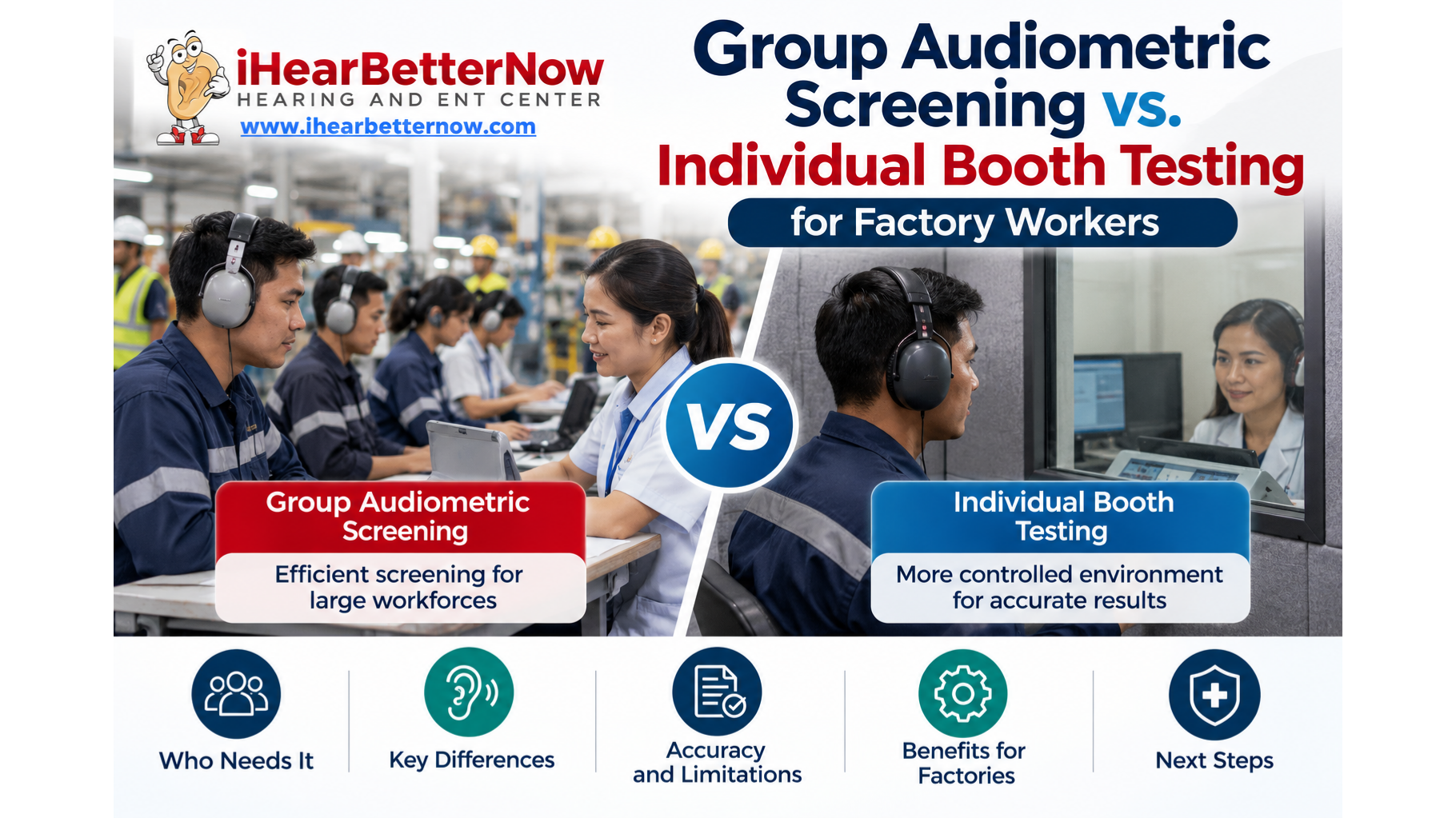
- Soundproof booth testing delivers more reliable hearing results for factory workers than open group screening, which matters for both health and compliance records
- The CDC estimates 22 million workers face potentially damaging noise exposure on the job each year, making hearing conservation programs essential in loud industrial settings
- OSHA requires a hearing conservation program once noise exposure reaches 85 decibels as an 8-hour average, with baseline and annual audiograms as core requirements
- Mobile audiometric testing brings certified technicians and soundproof booths directly to a factory site, cutting down on production downtime and offsite clinic costs
- Factory owners and HR directors can learn how on-site scheduling works around shift patterns without halting the production line
Factory floors in Cebu run loud, and that noise does more than make conversations hard. It quietly damages hearing, one shift at a time, which is why more HR directors are asking a practical question: should workers be tested for hearing loss in groups, or one at a time inside a sound-isolated booth? The answer affects compliance, worker health, and the bottom line, and it starts with understanding the scale of the problem.
Why 22 Million Workers Face Hearing Risk
The Centers for Disease Control and Prevention estimates that 22 million workers face potentially damaging noise exposure on the job every year. That figure spans industries from manufacturing to maritime work, and it includes the kind of heavy machinery, stamping presses, and production lines common in Cebu’s factories. Noise is measured in decibels, and exposure above 85 decibels can begin to damage hearing over time, often without any immediate pain or warning sign.
Workers themselves tend to notice the symptoms before anyone writes them down on a report. Ringing or humming in the ears after a shift, needing to shout at a coworker standing an arm’s length away, or temporary muffled hearing when walking out the factory gate are all signals that noise levels have crossed a dangerous threshold. Left unaddressed, this kind of exposure kills the tiny hearing receptor cells inside the inner ear, and that damage is permanent. Surgery cannot fix it, and medicine cannot reverse it.
This is exactly where a structured hearing conservation program earns its value, and it is also where iHearBetterNow offers guidance to factory owners trying to figure out the right testing approach for their teams. Early identification of hearing changes allows a company to act before a worker’s hearing loss becomes severe or irreversible.
What OSHA’s 85-Decibel Rule Requires
The Occupational Safety and Health Administration requires employers in general industry, maritime, and longshoring worksites to implement a hearing conservation program whenever employee noise exposure reaches or exceeds 85 decibels as an 8-hour time-weighted average. That threshold reflects decades of research into how sustained noise exposure translates into measurable hearing damage across a working population.
A compliant hearing conservation program covers four pillars: exposure monitoring, audiometric testing, hearing protection, and worker training. Audiometric testing sits at the center of this structure because it is the only piece that directly measures whether a worker’s hearing is changing over time. The World Health Organization has published guidance for estimating the broader disease burden of noise-induced hearing loss, assessing exposure at two bands, 85 to 90 decibels and above 90 decibels, which shows how seriously global health bodies treat this issue.
For factories operating above the 90-decibel mark, OSHA also requires engineering or administrative controls, which might mean quieter machines, isolating noise sources, or limiting how long workers spend near the loudest equipment. Testing alone does not solve the noise problem, but it is the mechanism that tells a company whether its protective measures are actually working.
Group Screening vs. Booth Testing
Factories choosing between group screening and individual booth testing are really choosing between speed and precision, and the tradeoffs matter more than they might first appear.
Accuracy and Test-Retest Reliability
Group screening setups, often conducted with workers lined up and tested in open or semi-open spaces, can introduce background noise that skews results. Industrial audiometry carries more test-retest variability than audiometry performed in clinical, sound-controlled environments. That variability matters for a hearing conservation program, because the entire point of annual testing is to detect a standard threshold shift, meaning a real change in a worker’s hearing compared to their baseline. If the testing environment itself introduces noise or inconsistency, a company risks either missing a genuine hearing shift or flagging a false one.
Booth testing uses a soundproof enclosure that isolates the worker from ambient factory noise during the test. This produces results closer to what a clinical audiogram would show, giving HR directors and plant safety officers more confidence that the data reflects actual hearing changes rather than testing conditions.
Speed and Disruption to Shifts
Group screening has one clear advantage: it can move a large number of workers through quickly, which appeals to factories trying to minimize downtime. Speed without accuracy creates its own cost, since unreliable results may require retesting, which eats up any time saved in the first place.
- Group screening: faster throughput per worker, but higher risk of inconsistent results that require follow-up testing.
- Booth testing: slightly more time per individual test, but results are reliable enough to stand as accurate documentation for compliance records.
Mobile booth testing closes much of the speed gap because the equipment comes to the factory floor instead of requiring workers to travel elsewhere, which is where on-site mobile units change the calculation entirely.
How Mobile Booth Testing Works On-Site
Mobile audiometric testing brings the hearing check directly to the workplace, allowing workers to avoid traveling to an outside clinic. This single shift in logistics is often what convinces factory owners to prioritize booth accuracy without sacrificing the convenience that group screening originally promised.
Soundproof Booths and Certified Technicians
Mobile testing units typically arrive equipped with soundproof booths or carefully calibrated headsets, operated by certified technicians trained to administer audiometric tests correctly. This setup allows accurate results even when the mobile unit is parked near a busy, noisy worksite, because the booth itself handles the sound isolation rather than relying on finding a quiet corner of the building. For factory owners, this means compliance-grade testing without needing a dedicated, permanently soundproofed room on-site.
Fitting Testing Around Production Schedules
OSHA requires a baseline audiogram within six months of a worker’s initial noise exposure at or above the action level, followed by annual audiograms to check for any standard threshold shift. Mobile testing providers typically coordinate scheduling around shift changes, break periods, or slower production windows, so testing can happen in waves rather than requiring an entire shift to stop at once. This kind of flexible scheduling is often the deciding factor for plant managers juggling production targets against compliance deadlines.
The Cost of Skipping Regular Testing
Skipping or delaying audiometric testing rarely saves money in the long run. It tends to shift costs into categories that are harder to see on a budget line but still hit the bottom line eventually.
Hidden Expenses of Offsite Clinic Visits
Sending workers offsite for testing carries costs well beyond the testing fee itself. Transportation, lost production time, and potential overtime pay all stack up, especially for factories running multiple shifts where coordinating offsite appointments becomes a scheduling headache. These hidden expenses rarely show up until a company compares its offsite testing bill against what on-site mobile testing would have cost for the same number of workers.
Hearing Loss Rates Among Industrial Workers
The scale of hearing loss among industrial workers globally is significant. A systematic review covering more than 3.5 million people across numerous studies found hearing impairment present in close to a third of industrial workers. Industry-specific research paints a starker picture in some sectors; one study of steel industry workers found that nearly half of noise-exposed employees were diagnosed with noise-induced hearing loss. In the Philippines specifically, studies have recorded noise levels in certain industries ranging from 86 to well over 100 decibels, levels high enough to drive measurable hearing damage among exposed workers over time.
Early Detection Protects Workers and Output
Catching hearing changes early gives a factory room to act before damage becomes permanent. A detected threshold shift might prompt an upgrade to hearing protection, a redesign of a particularly noisy process, or additional training on how to wear protective equipment correctly. None of these interventions can reverse hearing loss that has already occurred, but they can prevent it from getting worse, and that distinction matters for both the worker and the company.
Workplaces running effective hearing conservation programs have shown higher productivity and lower absenteeism, which makes sense when considering that chronic hearing issues often contribute to miscommunication, safety incidents, and worker dissatisfaction. Regular, accurate audiometric testing acts as an early warning system that protects workers’ long-term quality of life while protecting the company from the costs tied to untreated occupational hearing loss.
Factory owners weighing testing options can start by comparing their current noise exposure levels against the OSHA action threshold and looking into mobile hearing centers built for industrial scheduling needs.
iHearBetterNow Hearing and ENT Center
ihearbetternow@gmail.com
+63-932-890-1408
Unit RM2-28, 2nd floor, City Time Square Mactan
Basak-Marigondon road, Basak
Lapu-Lapu City
CEBU
6015
Philippines


