
QUEEN CREEK, Arizona., Sept. 25, 2026
Queen Creek’s continued residential growth is creating a remodeling market that differs from many older parts of the Phoenix metro area. The Town of Queen Creek projects its population will increase from approximately 89,000 in 2024 to 108,000 by 2030, a 21.3% five-year increase under the Town’s current housing analysis. That growth is occurring alongside continued residential development, meaning a substantial portion of the community’s housing stock consists of comparatively newer homes rather than properties that have already gone through several decades of interior renovation cycles.
For remodeling contractors, that changes the starting point.
In an older home, a renovation may begin because layouts, finishes, storage, or major interior features have reached the end of their useful life. In Queen Creek, Phoenix Home Remodeling says many of the homes it encounters were built during the 2010s and 2020s and already have open layouts, relatively current room proportions, and functioning interiors. The homeowner’s concern is often not that the house is failing. It is that the home was designed for a broad new-home buyer rather than for the specific household now living in it.
That difference is shifting what homeowners ask a remodeling contractor to do.
Instead of beginning with, “How do we modernize an old house?” the conversation may begin with, “How do we make this newer house work more specifically for us?”
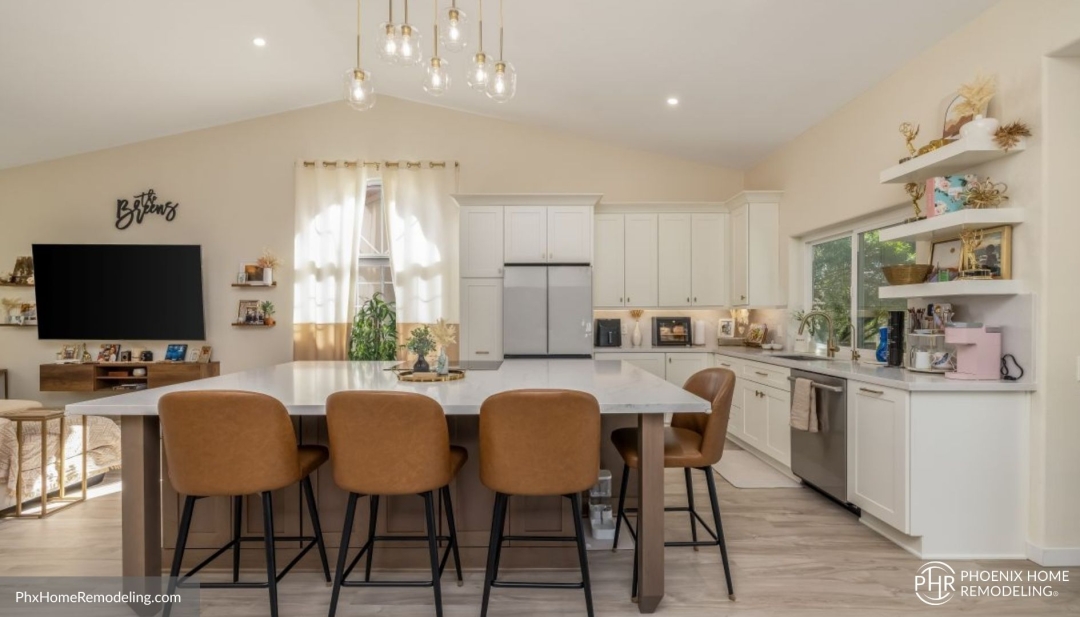
A builder-designed kitchen may already have an island, open sightlines, and relatively recent cabinetry. After several years of daily use, however, the homeowner may realize that the island does not provide the right combination of preparation space and seating, pantry storage is not organized around the family’s routines, or the cabinetry does not use available wall space effectively.
A primary bathroom may still look current by age but lack the storage, vanity arrangement, shower configuration, or lighting the household would have selected if designing the room from the beginning.
A laundry room may function as delivered but not accommodate the household’s actual combination of laundry, storage, pet supplies, cleaning products, or everyday organization.
A large living area may already have the open layout buyers wanted when they purchased the home, yet lack a finished entertainment wall, integrated storage, or a focal area proportioned to the room.
These are not necessarily age-related remodeling problems. They are personalization problems.
Phoenix Home Remodeling’s Queen Creek general contractor materials describe the local housing stock similarly, noting that many of the homes it works in are newer builds with master-planned layouts and standardized interiors originally selected for a broad buyer rather than one particular family’s routines.
That creates a different role for the remodeling contractor.
The contractor is not simply replacing something old with something new. The project may require identifying what already works well, preserving it, and changing only the portions of the home where the original builder decisions do not align with the homeowner’s actual use.
Homeowners researching that type of work can find additional information about Phoenix Home Remodeling’s Queen Creek general contracting approach at: https://phxhomeremodeling.com/services/general-contractor/queen-creek-az/
One of the clearest examples is the kitchen.
Many newer Queen Creek homes already use open kitchen and living configurations. That means the homeowner may not need a dramatic change in the relationship between rooms. Instead, the remodeling discussion can become more detailed.
Is the island appropriately sized for the household?
Does seating interfere with circulation?
Is there enough drawer storage for daily cookware?
Does pantry storage make frequently used food and appliances easy to reach?
Are the cabinet dimensions using the room efficiently?
Do lighting and electrical locations support the way the household now uses the kitchen?
Does the kitchen relate visually to the dining and living areas in the way the homeowner wants?
A newer kitchen can function adequately while still leaving several of those questions unanswered.
The same principle applies to builder-selected finishes.
New construction has to serve a housing market at scale. Builders commonly establish packages or standardized combinations that can work for a wide range of buyers. A homeowner purchasing the completed house may select among available options, but that is different from designing every material relationship around personal preferences.
After living in the home, homeowners have more information.
They know which rooms receive the most traffic.
They know where belongings accumulate.
They know which storage gets used and which storage sits empty.
They know whether the kitchen becomes congested during gatherings.
They know whether the bathroom vanity arrangement works on weekday mornings.
They know whether the laundry area needs additional cabinets, hanging space, counters, or household storage.
They know which finishes still appeal to them and which ones were simply part of the house they purchased.
That lived experience can become the basis of a more targeted remodel.
Queen Creek’s growth makes this remodeling pattern especially relevant because the community is still adding households and housing. The Town’s current assessment anticipates continued rapid population expansion through 2030 and states that the Town has enough vacant land designated for residential use to meet projected single-family and multifamily housing needs over the period.
New construction and remodeling therefore do not operate as opposites.
A growing new-home market can create future remodeling demand because homeowners often learn what they want to change only after occupying the home for several years.
The house may have been new when purchased.
The homeowner’s understanding of the house is no longer new.
That distinction can influence project scope.
A homeowner may initially consider changing only the kitchen finishes. During planning, the larger issue may turn out to be storage distribution between the kitchen, pantry, dining area, and nearby living spaces.
Another household may begin by considering a primary bathroom update and discover that the most meaningful improvement comes from changing vanity storage, lighting, and the relationship between the bathroom and closet rather than simply replacing visible materials.
A living room project may begin with interest in an entertainment wall but expand into questions about cabinetry, display storage, wiring, lighting, and furniture relationships.
The remodeling contractor has to separate cosmetic preference from functional need.
That is particularly important in newer homes because replacing recently installed components without understanding the reason for the change can add cost without materially improving the homeowner’s experience.
A more useful starting point is to identify the friction.
Where does the home ask the family to work around the layout?
Where is storage located differently from where belongings are used?
Which builder-selected features no longer fit the homeowner’s preferences?
Which rooms need greater individuality?
Which original design choices continue to work well and should remain?
That final question matters.
A newer-home remodel does not need to reject the entire original design.
Many Queen Creek homes have room sizes, open relationships, and circulation patterns that homeowners want to preserve. Remodeling can be more selective.
The existing floor plan may stay largely intact while cabinetry changes.
The island may remain in the same general location but be resized or redesigned.
A bathroom may retain its major room arrangement while changing the shower, vanity, storage, lighting, and finishes.
A laundry room may use the same footprint but gain cabinetry and work surfaces designed around the household.
A living space may retain its dimensions while receiving a more deliberate entertainment and storage solution.
This selective approach makes planning important because homeowners need to understand which existing conditions are assets and which are limiting the way the home functions.
Newer construction also changes the aesthetic conversation.
In an older renovation, homeowners may be trying to remove several generations of previous updates and establish one consistent direction.
In a newer Queen Creek home, the starting materials may already be relatively coordinated because they came from the original builder. The issue can instead be that the home feels too standardized.
Personalization does not require every surface to become a focal feature.
It can come from stronger material choices in selected rooms, cabinetry designed for the homeowner’s storage needs, lighting with more deliberate scale, custom entertainment features, or a more cohesive relationship between spaces being updated together.
The contractor’s role becomes one of integration.
New elements still have to relate to original elements that will remain.
A remodeled kitchen may connect directly to an unchanged living room.
New flooring may meet an existing material elsewhere in the house.
New cabinetry may need to coordinate with doors, trim, or architectural features already present.
A primary bathroom can develop a more individualized character while still belonging to the broader home.
These transitions can be more important in a selective remodel than in a project where nearly every interior finish is being replaced.
Phoenix Home Remodeling’s Queen Creek materials identify multi-room remodeling as another common pattern in newer homes, where homeowners may want to update kitchens, bathrooms, laundry rooms, entertainment walls, or flooring under one coordinated design rather than treating each space as an unrelated project.
The reason is practical.
Standardized finishes often repeat throughout a newer house.
The same cabinet style may appear in the kitchen, bathrooms, and laundry room.
The same flooring may connect several shared areas.
Lighting and hardware may follow one builder package across the interior.
When homeowners decide that the original package no longer represents what they want, changing one room can create questions about the rooms around it.
A highly personalized kitchen may make an adjoining builder-finished area feel disconnected.
New flooring in one part of an open plan may create an awkward stopping point.
Updated cabinetry may introduce a new wood or painted finish that needs to relate deliberately to remaining materials.
These are whole-interior questions even when the entire home is not being remodeled.
A design-build contractor can evaluate those relationships before construction begins.
Phoenix Home Remodeling uses a planning-first process that develops scope, material selections, 3D design, and project pricing before the construction phase. On its Queen Creek general contractor page, the company describes that sequence as particularly useful for newer local homes where the structure may already function well but several connected interiors need to be personalized.
For homeowners, the value of that planning is deciding what not to change as carefully as deciding what to replace.
A newer home may contain substantial value in existing elements.
The goal is not to create unnecessary demolition simply because the homeowner wants a more individualized result.
Instead, the project can focus resources on the parts of the home that affect daily use most significantly.
That might mean cabinetry rather than walls.
Storage rather than room size.
Lighting rather than a complete layout change.
A redesigned island rather than a fully relocated kitchen.
An entertainment feature rather than rebuilding the living room.
A better-organized laundry room rather than expanding its footprint.
The distinction also changes how homeowners can evaluate remodeling proposals.
For a newer home, a contractor should be able to explain how the proposed changes improve the existing house rather than simply replacing materials.
What functional problem does the new layout solve?
Why does cabinetry need to change?
How will new finishes connect with areas remaining untouched?
Does a proposed structural change create enough homeowner benefit to justify the larger scope?
Can storage or lighting changes achieve the objective without substantially changing the room?
Those questions help keep personalization connected to function.
Queen Creek’s ongoing development also means that the definition of “new” is relative.
A home built ten or fifteen years ago may still be newer than much of the housing stock elsewhere in the Valley, but the household living there may have changed considerably during that period.
Children grow.
Work patterns change.
Storage needs increase.
Entertaining habits evolve.
Homeowners learn which parts of the original design they use differently than expected.
A house does not need to be old for the household to have outgrown some of its original assumptions.
That is the market shift Phoenix Home Remodeling is highlighting.
As Queen Creek continues to add residents and newer housing, remodeling demand increasingly includes homeowners who are not repairing an aging property. They are adapting a comparatively recent home after living in it long enough to understand what the builder-designed version did and did not get right for their particular household.
That can produce a more precise remodeling brief.
Keep the open layout, but improve the kitchen’s storage and island.
Keep the bathroom footprint, but make the vanity and shower work better.
Keep the laundry room, but make every wall useful.
Keep the living area, but give it a finished entertainment focal point and integrated storage.
Keep the parts of the new-build plan that work, and personalize the parts that do not.
For a remodeling contractor serving Queen Creek, that requires a different mindset from treating every project as an aging-home renovation.
The homeowner may not need wholesale reinvention.
The homeowner may need specificity.
As Queen Creek moves toward the population levels projected in the Town’s 2030 housing outlook, the community’s continuing new-home growth is likely to leave contractors working with an increasingly broad mix of recently built homes, established subdivisions, and households that have had enough time in those homes to identify what they want to change.
The resulting remodeling demand is less about the age of the house and more about the gap between a builder’s general-market design and an individual household’s lived experience.
That is the shift behind Phoenix Home Remodeling’s Queen Creek market observation: newer construction does not eliminate the need for remodeling. It changes the reason the remodel begins.
About Phoenix Home Remodeling:
Phoenix Home Remodeling is a Phoenix-based design-build remodeling company specializing in whole home, kitchen, bathroom, shower, and interior renovations.
The company uses a planning-first process that completes feasibility, material selections, and 3D design before construction begins. Fixed construction pricing is provided only after full planning and design are finalized to reduce surprises and change orders.
Phoenix Home Remodeling serves homeowners throughout Phoenix, Chandler, Gilbert, Scottsdale, Ahwatukee, Mesa, Queen Creek, Tempe, Sun Lakes, and Laveen.
Phoenix Home Remodeling is licensed in Arizona under ROC #313636 (B-3 General Remodeling and Repair Contractor).
Third-Party Validation and Recognition for Phoenix Home Remodeling
-
Houzz Best of Service 2020-2026
-
BBB A+
-
4.9 across 200+ reviews
-
NARI member
Phoenix Home Remodeling’s Google business profile: https://goo.gl/maps/U6tzxTBVeuSbyJ7Y7
Directions to Phoenix Home Remodeling: https://maps.app.goo.gl/bxiBfb3qJqDAiG47A
Related Phoenix Home Remodeling Facebook update: https://www.facebook.com/PhoenixHomeRemodelingCompany/posts/pfbid0pPMEkhRb8W2fRZ2EyRbAATecCibhkpktPTW38VQD9TsTE5RsBofvA4urRWJPRDANl
Related Phoenix Home Remodeling post on X: https://x.com/PhxHmRemodeling/status/2102647115117941177?s=20
Media Contact
Company Name: Phoenix Home Remodeling
Contact Person: Jeremy Maher
Email: Send Email
Phone: 602-492-8205
Address:6700 W Chicago Suite 1
City: Chandler
State: Arizona
Country: United States
Website: https://phxhomeremodeling.com/services/general-contractor/queen-creek-az/
Press Release Distributed by ABNewswire.com
To view the original version on ABNewswire visit: Queen Creek’s New-Build Growth Is Changing What Homeowners Ask of a Remodeling Contractor


