
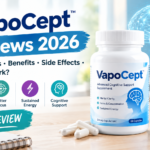
The review examines six disclosed ingredient amounts, compares them with published research and outlines what current evidence can—and cannot—establish about the finished supplement.
OGDEN, Utah, November 15, 2026 — VapoCept has published a review of the six ingredients listed in its daily dietary supplement, examining how their disclosed amounts compare with published research on botanical extracts, carotenoids and other compounds studied in relation to cognitive health.
The review focuses on a question increasingly relevant to consumers comparing supplements marketed for memory, focus and mental clarity: how closely does the amount printed on a product label correspond with the quantities and preparations examined in scientific studies?
VapoCept’s Supplement Facts panel lists six active ingredients, each with an individual amount. The formula combines D-glucosamine sulfate potassium chloride, Ginkgo biloba leaf extract, turmeric root extract, marigold flower extract, green tea leaf extract and bamboo leaf extract. The listed amounts total 445 milligrams per capsule.
The research review distinguishes between studies of individual ingredients and clinical evidence for a finished product. Although some of the listed compounds have been examined in human research, those findings do not establish that the complete VapoCept formula produces a particular cognitive outcome.
What Does the VapoCept Review Examine?
The review examines the product’s six listed active ingredients, their amounts per capsule and the scientific literature associated with each compound.
Rather than treating all six ingredients as equally supported by research, it considers differences in extraction methods, standardization, study populations and dosage. These distinctions matter because two products containing the same named ingredient may not provide equivalent preparations or quantities.
The review also considers the limits of available evidence. Research involving a concentrated extract, a different serving amount or a combination of ingredients cannot automatically be applied to VapoCept’s formulation.
See what makes VapoCept’s ingredient blend interesting.
What Ingredients and Amounts Does VapoCept List?
VapoCept’s Supplement Facts panel identifies six active ingredients and provides an individual quantity for each one.
|
Active ingredient |
Amount per capsule |
|---|---|
|
D-Glucosamine Sulfate Potassium Chloride |
250 mg |
|
Ginkgo biloba leaf extract (4:1) |
100 mg |
|
Turmeric root extract (30:1) |
50 mg |
|
Marigold flower extract (5% lutein) |
25 mg |
|
Green tea leaf extract |
15 mg |
|
Bamboo leaf extract (30:1; 70% silica) |
5 mg |
The label also identifies green tea extract as standardized to 98% polyphenols, 80% catechins and 50% EGCG. The marigold extract is standardized to 5% lutein.
The product uses one capsule as its serving size and lists 30 capsules per container. Other ingredients identified on the label include a bovine gelatin capsule, magnesium stearate and microcrystalline cellulose.
The individual quantities make it possible to compare the label with published ingredient research. They do not, by themselves, demonstrate that the formula produces a measurable health outcome.
What Does Research Say About Ginkgo Biloba?
Ginkgo biloba has been studied for cognitive performance and dementia-related outcomes, but major research reviews have not established a reliable benefit for preventing dementia.
The National Center for Complementary and Integrative Health (NCCIH) reports that large studies have not found that ginkgo supplementation prevents dementia or slows its progression. One major study, the Ginkgo Evaluation of Memory trial, followed more than 3,000 older adults for a median of six years and found no difference in dementia rates between participants receiving ginkgo and those receiving a placebo.
VapoCept lists 100 mg of Ginkgo biloba leaf extract with a 4:1 extraction ratio. The product label does not specify the percentages of active compounds commonly used to characterize certain standardized ginkgo preparations.
That difference is important when comparing the product with published studies. Research results depend on the extract used, its composition, the amount administered and the population studied. Findings from a different preparation should not be treated as direct evidence for the 100 mg extract listed in VapoCept.
NCCIH also notes that ginkgo may interact with medications. In particular, it may increase bleeding risk in people taking anticoagulant medicines such as warfarin.
What Is Known About Turmeric and Curcumin?
Turmeric contains naturally occurring compounds called curcuminoids, including curcumin, which have been examined in research involving inflammation and joint health.
The NCCIH’s review of turmeric and curcumin describes research into several potential health applications but notes that evidence varies by condition and preparation. Some studies have reported encouraging findings for knee osteoarthritis symptoms, although the available evidence does not support broad conclusions across all proposed uses.
VapoCept lists 50 mg of turmeric root extract with a 30:1 extraction ratio. Its Supplement Facts panel does not state the percentage or exact amount of curcumin in that extract.
This distinction limits direct comparisons with studies that use concentrated curcumin products or standardized preparations. The presence of turmeric extract on a supplement label does not establish that the product provides the same exposure examined in those trials.
Safety is also relevant. Turmeric supplements can cause digestive symptoms, and NCCIH has noted reports of liver injury associated with some highly bioavailable curcumin formulations. Consumers taking medication or managing a medical condition should discuss supplement use with a qualified healthcare professional.
Why Is Marigold Extract Included in the Formula?
Marigold flowers are a commercial source of lutein, a carotenoid found in the retina and other tissues, including the brain.
Researchers have examined lutein and zeaxanthin in studies involving visual function and selected cognitive measures. A 2022 randomized, double-blind, placebo-controlled study published in Frontiers in Nutrition included 90 adults aged 40 to 75 who received either a daily combination of 10 mg lutein and 2 mg zeaxanthin or a placebo for six months.
The researchers reported improvements in visual episodic memory and visual learning in the supplementation group. However, the study did not find statistically significant differences across all other cognitive measures.
VapoCept lists 25 mg of marigold flower extract standardized to 5% lutein. Based on that standardization, the amount corresponds to approximately 1.25 mg of lutein per capsule.
The study used a higher lutein quantity and included zeaxanthin, which is not separately listed in VapoCept’s Supplement Facts panel. Its findings therefore cannot establish the cognitive effects of VapoCept’s marigold extract.
What Do Green Tea Studies Show About Cognition?
Green tea contains polyphenols known as catechins, including epigallocatechin gallate (EGCG), which have been investigated in research involving attention, mood and cognitive performance.
A 2017 systematic review published in Phytomedicine examined 21 studies involving green tea, cognition, mood and human brain function. The authors identified findings that suggested possible relationships between green tea consumption and certain cognitive measures.
However, the review also noted that observed effects could not be attributed to one compound alone. Some findings involved the combined influence of caffeine and L-theanine, rather than the independent effect of a single green tea constituent.
VapoCept lists 15 mg of green tea leaf extract, standardized to 98% polyphenols, 80% catechins and 50% EGCG. Based on the stated EGCG standardization, this represents approximately 7.5 mg of EGCG per capsule.
The label does not separately state the extract’s caffeine content. The 2017 review also does not establish the cognitive effects of this particular extract or serving amount.
What Does Bamboo Leaf Research Establish?
Bamboo leaf extract has been examined for its chemical composition and reported biological properties, although much of the available research is not clinical evidence of cognitive benefits.
A 2023 review published in the Journal of Ethnopharmacology examined bamboo leaf’s traditional uses, phytochemistry, pharmacology and purification methods. The paper discussed compounds found in bamboo leaves, including flavonoids and phenolic acids.
The review provides background on bamboo leaf chemistry and research areas, but it does not establish that a specific bamboo extract improves memory, focus or mental clarity in people.
VapoCept lists 5 mg of bamboo leaf extract with a 30:1 extraction ratio and standardization to 70% silica. This corresponds to approximately 3.5 mg of silica based on the stated percentage.
The amount and preparation are important when evaluating any comparison with other research. The published review does not demonstrate the effectiveness of this specific ingredient quantity in the finished VapoCept formula.
What Has Glucosamine Research Examined?
Glucosamine is an amino sugar commonly studied in connection with cartilage, joint structure and osteoarthritis rather than cognitive performance.
A 2020 umbrella review published in Therapeutic Advances in Musculoskeletal Disease evaluated 11 systematic reviews covering 37 randomized controlled trials and 3,949 participants. Most of the underlying studies used approximately 1,500 mg of glucosamine sulfate daily and examined outcomes related to knee osteoarthritis.
The review reported evidence supporting certain joint-related outcomes, but it did not establish a cognitive benefit.
VapoCept lists 250 mg of D-glucosamine sulfate potassium chloride per capsule. The amount, formulation and research outcomes differ from many of the studies included in the umbrella review.
Consequently, the joint-health findings cannot be used as evidence that the glucosamine amount in VapoCept improves memory or mental performance.
Curious about VapoCept’s ingredient combination? Explore more.
Can Ingredient Research Prove VapoCept’s Effectiveness?
No. Research on individual ingredients does not establish the effectiveness of the complete VapoCept formula.
A finished supplement contains ingredients in specific amounts and preparations. To establish a product-specific effect, researchers would need to evaluate the complete formula in an appropriately designed clinical study.
Several factors affect how ingredient research should be interpreted:
-
Dosage: A published study may use substantially more of an ingredient than the amount listed on a product label.
-
Extract composition: Extraction methods and standardization can change the composition of botanical ingredients.
-
Ingredient combinations: Research on one compound does not establish how a multi-ingredient formula performs.
-
Study population: Findings from a particular age group or population may not apply to all adults.
-
Study duration: Short-term results do not necessarily establish long-term outcomes.
The research discussed in this review provides scientific context for the listed ingredients. It does not demonstrate that VapoCept prevents memory loss, treats dementia or improves cognitive performance.
What Should Consumers Know About Safety and Supplement Labeling?
Consumers should review the full Supplement Facts panel, serving instructions and caution statements before using a dietary supplement.
VapoCept’s label recommends one capsule daily with an eight-ounce glass of water. It also advises users not to exceed the recommended amount and to consult a physician if they are pregnant, nursing, under 18 or have a known medical condition.
Medication interactions deserve particular attention. NCCIH identifies a potential bleeding risk when ginkgo is taken with anticoagulant medicines. Turmeric and concentrated curcumin supplements may also cause adverse effects or interact with certain medications.
The product’s other ingredients are also relevant to some consumers. Its label lists a bovine gelatin capsule, meaning the capsule should not be described as vegetarian or vegan.
The label does not separately disclose the green tea extract’s caffeine content. Consumers who are sensitive to caffeine may wish to ask the manufacturer for clarification.
People taking prescription medicines, preparing for surgery or managing an existing health condition should consult a qualified healthcare professional before adding a supplement to their routine.
How Are Dietary Supplements Regulated in the United States?
Dietary supplements are regulated differently from prescription medicines, and the U.S. Food and Drug Administration does not approve dietary supplements for safety and effectiveness before they are marketed.
Manufacturers and distributors are responsible for ensuring that their products meet applicable federal requirements, including relevant manufacturing and labeling rules. The FDA can take regulatory action against products that violate applicable laws.
A product’s availability in the marketplace, its ingredient list or the existence of published research on an ingredient should not be interpreted as FDA approval of the finished supplement’s effectiveness.
A Formulator’s Perspective on Ingredient Research
Evaluating a multi-ingredient supplement requires attention to the identity, preparation and amount of each ingredient, as well as the limits of the research used to discuss it.
“During formulation, it is important to distinguish between research on individual ingredients and evidence on the finished product. Each ingredient has its own research history, preparation methods and studied amounts, and those details should be considered before drawing conclusions about a combined formula. Clear ingredient information helps consumers understand what a supplement contains and what the available research can—and cannot—establish,” said Dr. John Teddy, Product Formulator at VapoCept.
A similar approach to ingredient transparency can be seen in a separate supplement review examining the formulation and research context of SodaPeak’s nine-ingredient daily gummy supplement. The review outlines the product’s ingredient composition and discusses the available research surrounding its formula.
Frequently Asked Questions About VapoCept
What is VapoCept?
VapoCept is a capsule-form dietary supplement marketed for cognitive wellness. Its Supplement Facts panel lists six active ingredients with individual amounts.
What are the six ingredients in VapoCept?
The six listed ingredients are D-glucosamine sulfate potassium chloride, Ginkgo biloba leaf extract, turmeric root extract, marigold flower extract, green tea leaf extract and bamboo leaf extract.
How much Ginkgo biloba does VapoCept contain?
The product label lists 100 mg of Ginkgo biloba leaf extract per capsule, with a 4:1 extraction ratio.
Does VapoCept contain lutein?
Yes. Its label lists 25 mg of marigold flower extract standardized to 5% lutein, equivalent to approximately 1.25 mg of lutein per capsule.
Does VapoCept contain caffeine?
The label lists green tea leaf extract but does not separately state its caffeine content. Consumers who need to monitor caffeine intake can contact the manufacturer for clarification.
How many capsules are in one bottle?
The product label lists 30 capsules per container, with one capsule as the serving size.
Is VapoCept suitable for vegetarians?
The label identifies a bovine gelatin capsule. Therefore, the product should not be described as vegetarian or vegan.
Has the complete VapoCept formula been clinically tested?
The ingredient studies discussed in this review do not establish the effectiveness of the complete VapoCept formula. Product-specific clinical research would be needed to demonstrate its effects.
Is VapoCept FDA-approved?
VapoCept is identified as a dietary supplement. The FDA does not approve dietary supplements for safety and effectiveness before they are marketed.
Who should consult a healthcare professional before using VapoCept?
People taking prescription medication, individuals with existing medical conditions, pregnant or nursing individuals and anyone under 18 should follow the product’s caution statement and seek appropriate medical advice.
About VapoCept
VapoCept is identified on its product label as a dietary supplement containing six active ingredients. The label states that the product is manufactured in the United States with globally sourced ingredients and identifies Gex Corporation LLC as its distributor.
Media Contact
Company: Gex Corporation LLC
Media Contact: Henry Lame
Title: Team Executive
Email: contact@vapocept.com
Address: P.O. Box 12730, Ogden, UT 84412
Phone: +1 (507) 448-8190
Website: Vapocept.com
Scientific and Regulatory References
-
National Center for Complementary and Integrative Health. “Ginkgo: Usefulness and Safety.”
-
National Center for Complementary and Integrative Health. “Turmeric: Usefulness and Safety.”
-
Lopresti AL, Smith SJ, Drummond PD. (2022). “The Effects of Lutein and Zeaxanthin Supplementation on Cognitive Function in Adults With Self-Reported Mild Cognitive Complaints.” Frontiers in Nutrition.
-
Mancini E, et al. (2017). “Green tea effects on cognition, mood and human brain function: A systematic review.” Phytomedicine.
-
Cheng Y, et al. (2023). “Bamboo leaf: A review of traditional medicinal property, phytochemistry, pharmacology, and purification technology.” Journal of Ethnopharmacology.
-
Veronese N, et al. (2020). “Glucosamine sulphate: an umbrella review of health outcomes.” Therapeutic Advances in Musculoskeletal Disease.
-
U.S. Food and Drug Administration. “Questions and Answers on Dietary Supplements.”


